


Definition
ADALINE (Adaptive Linear Neuron) is a single-layer neural network used for regression and classification tasks. It is based on a linear model and works by adjusting the weights using a gradient descent method to minimize the error (the difference between predicted and actual outputs).
In simpler terms
ADALINE is an early artificial neural network developed in 1960 that works like a simple learning machine. It takes multiple inputs, assigns different importance weights to each one, adds them up (along with a bias term), and produces an output.
ADALINE was innovative in the way it learns: when it makes a mistake, it calculates how far off it was and figures out which direction to adjust its weights to reduce that error. This method, called gradient descent, allows it to automatically fine-tune its weights and gradually improve over time. Unlike earlier networks, it adjusted its weights before making its final decision, which made its learning more stable and reliable.
ADALINE's historical significance
ADALINE represented a major methodological breakthrough in the history of neural networks. In 1960, Bernard Widrow, Professor of Electrical Engineering at Stanford University, and his doctoral student Marcian Hoff, introduced gradient descent learning to neural systems, establishing a training method that remains fundamental to virtually all modern AI. Although their aim was not to model human cognition, they developed a more efficient learning algorithm capable of continuous improvement rather than learning only from explicit errors. As a result, ADALINE learned significantly faster and more reliably than earlier approaches.
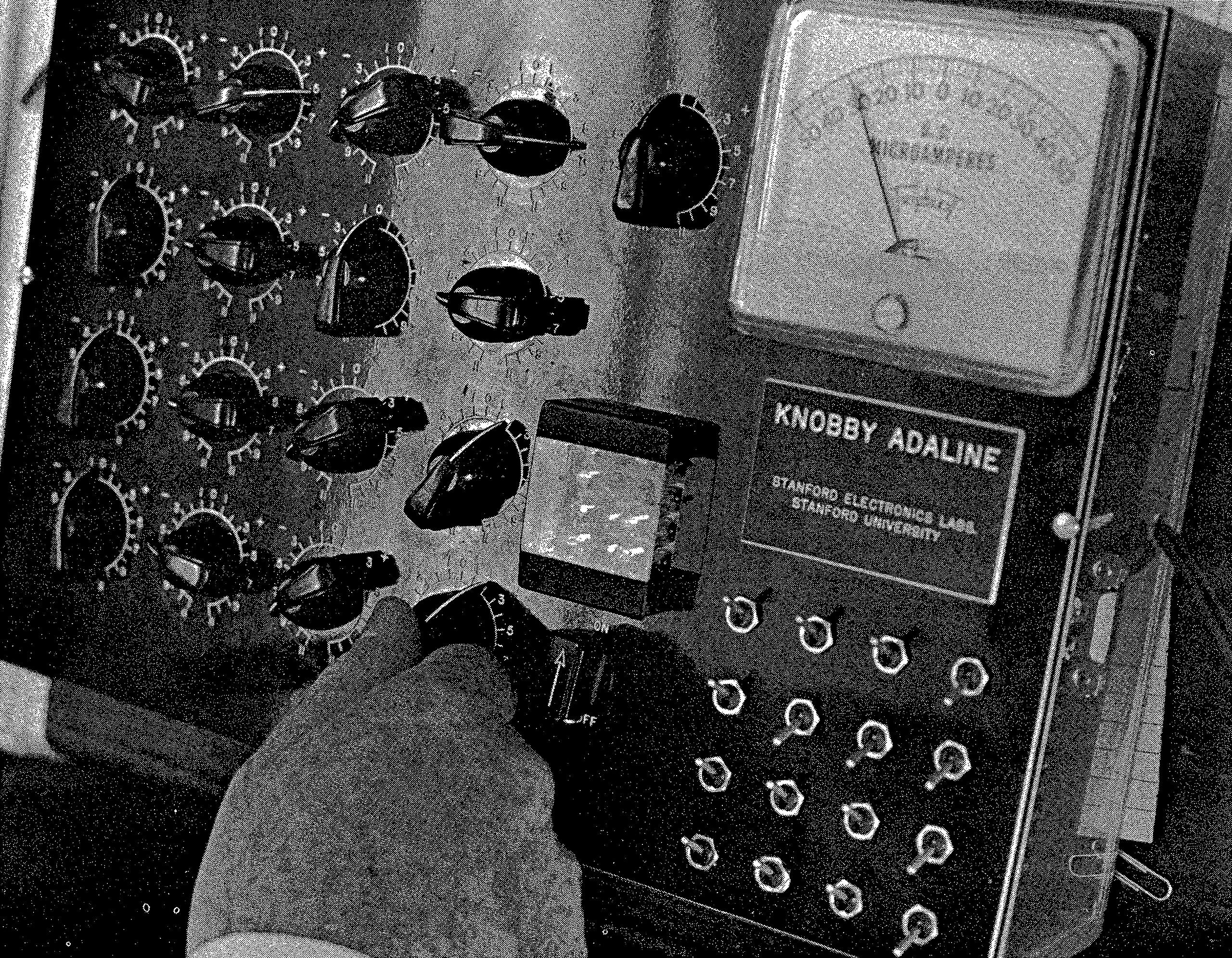
In the early 1960s, the algorithm was implemented in dedicated hardware known as the Knobby ADALINE. Since running algorithms on mainframe computers was slow and expensive in 1960, Widrow and Hoff constructed a physical electronic device with adjustable rheostats that allowed the network’s weights to be modified by turning knobs by hand.
What ADALINE was and is used for
ADALINE found its greatest success in adaptive signal processing and telecommunications, not in modelling human cognition. The key technologies it enabled include:
- Adaptive noise cancelling: Filtering unwanted noise from audio signals (this technology is now used in noise-cancelling headphones)
- Adaptive antennas: Automatically adjusting antenna patterns to optimize signal reception
- Adaptive equalisation in high-speed modems: Compensating for signal distortion in data transmission, which improves, for example, WiFi signals.
ADALINES limitations
ADALINE worked well for simple tasks, but it had important weaknesses that limited its application:
- It could only handle simple problems, as it learned by drawing straight line boundaries, which worked for clearly different cases but failed when data overlapped or looked similar.
- It was also very sensitive to its learning rate, as values that were too large caused the system to become unstable, while values that were too small made learning extremely slow.
These problems led researchers to develop multi layer neural networks in the 1980s, trained using backpropagation. By stacking layers of neurons, these systems could learn curved and more complex patterns, allowing neural networks to handle more difficult tasks.
The Key Take-Aways
- ADALINE, developed in 1960, was one of the first neural networks to learn using gradient descent.
- The key innovation was introducing a stable learning method that still underpins modern artificial intelligence.
- It demonstrated that neural networks could improve continuously rather than learning only from explicit mistakes.
- Its influence helped shape the training methods used in virtually all modern AI systems.